
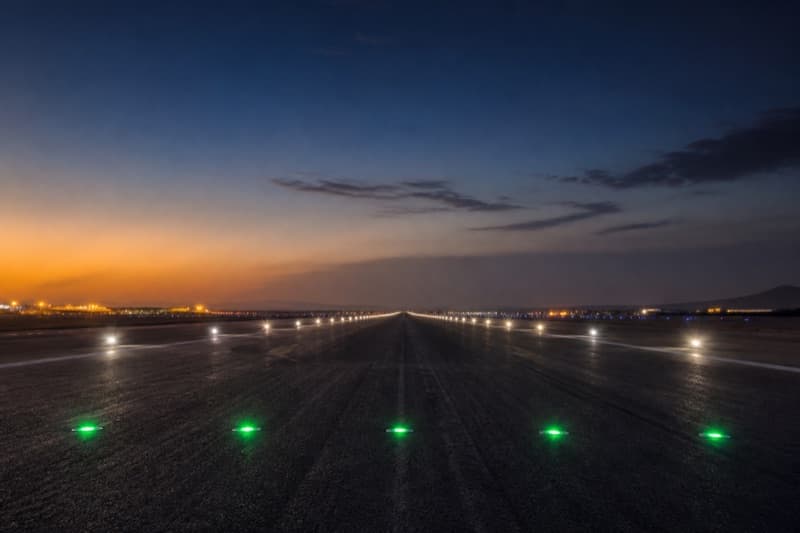
Airfield Ground Lighting
Northlane Solutions supplies and installs runway edge lights, threshold lights, taxiway lighting, PAPI systems, approach lighting and airfield guidance signs for Saudi airports and airfields, engineered to ICAO Annex 14 Volume I and FAA AC 150/5340-30 with photometrics and layout matched to the runway category and approach type of each site.
A runway at night is read entirely through its lighting. A pilot on approach has no other reference for the runway edge, the threshold, or the point where the surface ends, so the layout, color coding and intensity of every fitting is fixed by international standard rather than by preference, and a system built outside that standard is not a lesser version of the real thing, it is unsafe.
What the system covers
Runway edge lighting marks the lateral limits of the usable surface in white, switching to yellow on the final section of runways of 2,400 metres or more to warn of the approaching end. Threshold and runway end lights mark where the runway begins and ends in green and red respectively, visible from opposite directions so a pilot always reads the correct one. Taxiway lighting, typically blue edge lights with green centreline lighting on more complex layouts, guides aircraft on the ground once they have left the runway. PAPI, the precision approach path indicator, gives a pilot a visual glide slope reference on final approach through a bar of lights that reads red, white or a combination depending on whether the aircraft is above, on, or below the correct path. Approach lighting systems extend that guidance further out from the threshold for lower visibility operations, and airfield guidance signs identify taxiway intersections, runway holding positions and mandatory instructions so ground movement stays unambiguous even at night or in reduced visibility.
Standards and specification
Northlane Solutions engineers every airfield ground lighting package to ICAO Annex 14 Volume I and, where the design reference is American, FAA AC 150/5340-30, matching fitting photometrics, spacing and color to the runway category, approach type and the specific configuration of the airfield rather than applying one generic layout. The correct configuration depends on runway length, the approach category it is certified for, and whether operations are expected at night or in low visibility, and NLS works from the aerodrome's own certification basis rather than a default assumption.
Delivery
NLS supplies fittings from established international aviation lighting manufacturers and carries the project from layout design through supply, installation and commissioning, then into the control and monitoring systems, series circuits and cabling that keep the lighting operating as one coordinated system rather than a set of independent fixtures. Maintenance and photometric retesting follow once the system is commissioned, so performance is verified against the standard on an ongoing basis rather than assumed from the installation date.
Related products






Guides
Planning a Halogen to LED Airfield Ground Lighting Conversion
How to plan a halogen to LED airfield ground lighting conversion: CCR compatibility checks, mixed-circuit operation during phasing, photometric requirements, and sequencing work without closing the runway.
Saudi Aviation Infrastructure Glossary: A to Z Terms Buyers Need
A practitioner glossary of the aviation infrastructure terms buyers meet on Saudi projects, covering airfield ground lighting, heliport design, obstruction lighting, arresting systems and the regulatory acronyms behind GACAR and ICAO Annex 14.
Planning an Airfield Ground Lighting Project in Saudi Arabia
How to plan an airfield ground lighting project in Saudi Arabia: scoping runway, taxiway and approach systems, control and monitoring integration, halogen versus LED, phasing around live operations, and spares strategy.
PAPI Systems Explained: How Four Light Units Guide an Approach
What a PAPI system is, how its four light units signal approach slope, the siting and calibration basics that determine accuracy, and the recurring maintenance obligations that keep it airworthy.
Frequently Asked Questions
What standard governs runway lighting color and spacing?+
ICAO Annex 14 Volume I, and FAA AC 150/5340-30 where the design reference is American. Both set the color coding, intensity and spacing for edge, threshold, and taxiway lighting according to runway category and approach type.
What does a PAPI system actually show a pilot?+
A bar of lights that reads as red, white or a mix depending on whether the aircraft is above, on, or below the correct glide path on final approach, giving continuous visual glide slope guidance.
Why does runway edge lighting change from white to yellow near the end?+
On runways of 2,400 metres or more, the final section switches to yellow to warn a pilot on take off or landing roll that the runway end is approaching, well before it becomes visible.
Can Northlane Solutions retrofit lighting on an existing airfield?+
Yes. NLS assesses the existing layout against the aerodrome's current certification basis and supplies and installs replacement or upgraded fittings, cabling and control equipment to bring the system into line with the applicable standard.