
Surface Friction Testing
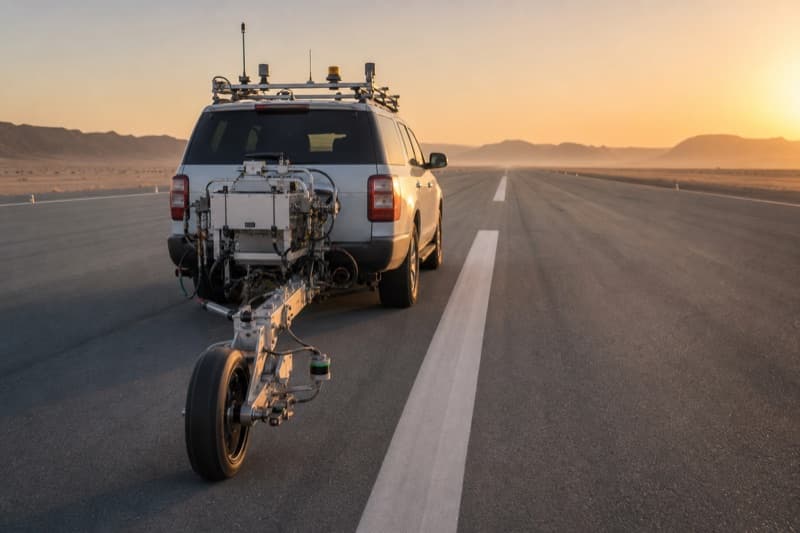
Northlane Solutions provides continuous friction measuring equipment and runway and heliport friction testing services for Saudi airfields, generating the objective friction data a pavement maintenance programme needs to decide whether rubber removal, resurfacing or other pavement maintenance is actually needed before it becomes a safety issue.
Friction is one of the few runway characteristics that cannot be judged reliably by looking at the surface. A pavement can look sound and still deliver friction below the level a landing aircraft needs, particularly in and around the touchdown zones where rubber deposit and polishing accumulate fastest, and the only way to know the real number is to measure it under controlled conditions rather than infer it from visual inspection.
What continuous friction measuring equipment does
A continuous friction measuring device runs a test wheel along the runway at a controlled slip ratio and speed, usually with a water film applied ahead of the wheel to simulate wet runway conditions, since dry friction rarely drops to a level that matters while wet friction is where most operationally significant loss shows up. The result is a continuous friction reading along the full runway length rather than a handful of spot checks, which matters because friction loss is rarely uniform. It concentrates in touchdown zones and other high traffic areas, and a testing method that only samples a few points can miss exactly the section that has degraded.
How the data gets used
Measured friction is compared against the maintenance planning levels the operator's own pavement management programme and the civil aviation authority set for that runway, and a reading approaching those levels triggers a maintenance response, most often rubber removal, before operational restrictions become necessary. This turns rubber removal and resurfacing decisions into evidence based maintenance rather than a fixed calendar interval that either wastes closure time on a runway that did not need it or leaves a genuinely degraded surface in service too long.
Heliport friction testing
Heliport touchdown and lift off areas face the same rubber accumulation and surface degradation mechanisms as runways, on a smaller surface, and periodic friction testing applies there for the same reason: to catch a genuine drop in surface performance before it affects an approach or landing rather than after.
Delivery
Northlane Solutions operates continuous friction measuring equipment and schedules testing to fit the closure windows an operating airfield can actually provide, delivering a friction survey report referenced against the applicable planning levels so the operator has an objective basis for the next maintenance decision rather than a subjective visual judgment.
Related products
Guides
Runway Rubber Removal and Friction Testing: Why Airports Schedule Both Together
Why rubber deposits from landing aircraft drive runway friction loss, how friction testing catches it, why ultra high pressure water removal is the standard method, and how airports build a rubber removal schedule around traffic volume.
Offshore Helideck Requirements Under CAP 437: What Operators Need to Know
What CAP 437 actually requires on an offshore helideck: perimeter lighting, status lights, friction, drainage, net versus no-net deck design, and the inspection routine that keeps a deck operational.
Frequently Asked Questions
Why can't runway friction be judged by looking at the surface?+
Rubber deposit and surface polishing in touchdown zones can lower friction below a safe level while the pavement still looks sound visually. Only a controlled measurement under simulated wet conditions gives the actual number.
How often should runway friction testing be carried out?+
Frequency follows traffic volume and the friction assessment provisions in Annex 14 rather than one fixed interval for every airfield. A pattern of readings approaching the maintenance planning level is what triggers more frequent testing.
What happens after a friction reading falls below the planning level?+
It triggers a maintenance response, most often rubber removal in the affected zone, followed by retesting to confirm the friction has been restored before the section is considered cleared.
Does surface friction testing apply to heliports as well as runways?+
Yes. Heliport touchdown and lift off areas face the same rubber accumulation mechanism on a smaller surface, and periodic testing there catches a genuine drop in surface performance before it affects an approach or landing.
Do you supply skiddometers or runway friction testers?+
Yes. Skiddometer is the name of one well-known friction tester that many tenders use for the whole category. We supply continuous friction measuring equipment and carry out runway and heliport friction surveys across Saudi Arabia, and can quote a specific make and model on request.