
Heliport Wind Cones (Windsocks)
Also called: helipad windsock, heliport windsock, helideck windsock, wind sock
Heliport wind cones are sized and positioned to the wind indicator requirements in ICAO Doc 9261 and CAP 437 for helidecks, giving helicopter pilots a clear read on surface wind during approach, hover, and departure at rooftop, ground-level, and offshore-style heliports. NLS supplies and installs heliport wind cones as part of turnkey heliport lighting and marking packages.
Inside the Heliport Wind Cones
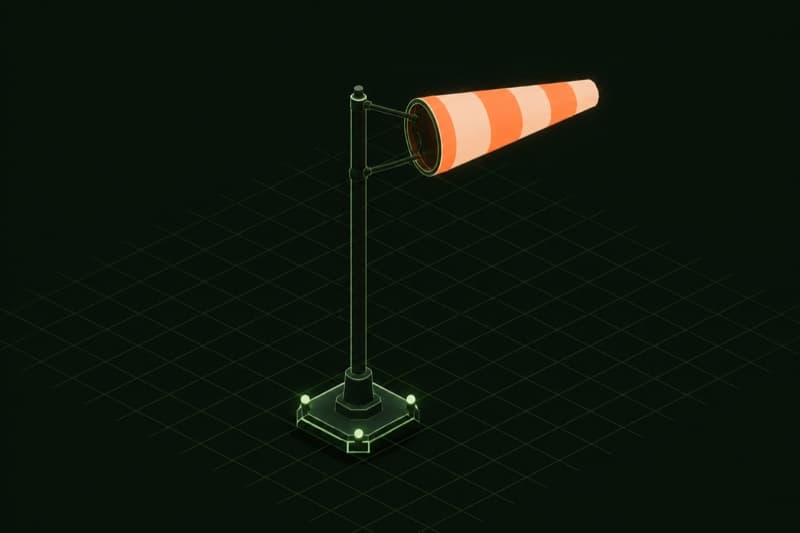
A heliport wind cone is a mains or circuit-fed wind indicator sized and lit for a helicopter landing site, with an internal light source built into the frame or mast rather than a separate solar supply. The fabric cone, frame, and illuminated mast form one assembly that gives pilots a continuous day and night read of wind direction.

01
Windsock Fabric Cone
The tapered high-visibility fabric sleeve, sized for heliport wind indication, that fills and orients with the wind to give pilots a direct read of direction and approximate speed.

02
Frame and Swivel Head
Holds the cone's mouth open on a free-rotating swivel so the assembly turns with wind direction, mounted to the illuminated top section of the mast.

03
Internal Light Source
A lamp or LED unit inside the frame or upper mast section that illuminates the cone from within, keeping wind indication visible at night on the site's own power circuit.

04
Power Cable Entry
Feeds power from the heliport's lighting circuit up through the mast to the internal light source, sealed at the entry point against moisture ingress.

05
Mast and Frangible Base
Supports the illuminated head at the height required for pilot visibility from the approach and hover positions, coupled to a frangible base so it breaks away safely if struck.
FULLY ASSEMBLED
Heliport Wind Cones


| Power source | Grid or circuit-fed via the heliport's lighting network |
| Illumination | Internal light source built into frame or mast head for continuous night visibility |
| Mounting | Frangible mast base, sited for unobstructed pilot sightline |
| Cone material | High-visibility fabric, colored per applicable aviation marking convention |
| Rotation | Free swivel head, no external orientation drive |
| Typical siting | Hospital helipads, offshore and onshore heliports, grid-connected sites |
A different sizing problem than fixed-wing fields
Helicopters are far more sensitive to gusting and rotor downwash effects near the landing surface than fixed-wing aircraft, and a heliport wind cone often sits much closer to the touchdown point than an airfield cone does to a runway. Positioning has to account for turbulence generated by the structure itself, whether that is a rooftop heliport on a hospital or tower, a ground-level pad, or an offshore-style deck. NLS designs heliport wind cone placement against ICAO Doc 9261 heliport manual guidance and CAP 437 helideck criteria rather than reusing fixed-wing airfield spacing.
Rooftop and ground-level considerations
Rooftop heliports need a mounting solution that clears the roofline and any adjacent plant or parapet without creating its own obstruction, while still keeping the cone visible to a pilot on final approach from multiple directions. Ground-level pads have more flexibility on positioning but still need the frangible mast and obstacle-clearance treatment required near the approach and takeoff funnel. NLS assesses each heliport individually rather than applying a single standard layout.
Illumination for night medevac and VIP operations
A significant share of heliport traffic in Saudi Arabia is hospital medevac and executive transport, both of which routinely operate after dark. NLS specifies illuminated heliport wind cones as standard on any pad supporting night operations, with the same choice between mains-fed and solar-independent power as on fixed-wing sites, so power availability at a rooftop or remote pad does not compromise the wind indication.
Supplied as part of a full heliport lighting package
Wind cones are rarely the only marking element on a heliport project. NLS delivers the wind cone alongside heliport perimeter lighting, floodlighting, TLOF and FATO markings, and obstruction lighting as one turnkey scope, so the wind indicator is coordinated with the rest of the visual aids on the pad rather than procured and positioned separately. Sourcing is from established international aviation lighting OEMs, with design, supply, installation, and commissioning under a single point of contact.
Compliance verification
Before handover, NLS verifies the wind cone's position, mounting height, and illumination performance against the applicable heliport design standard for that pad, whether ICAO Doc 9261, CAP 437, or the client's own operator specification, and documents this as part of the commissioning record.
Specifications
- ✓Positioned to ICAO Doc 9261 heliport manual and CAP 437 helideck wind indicator guidance
- ✓Suited to rooftop, ground-level and offshore-style heliport configurations
- ✓Illuminated as standard for pads supporting night medevac or VIP operations
- ✓AC mains or solar-powered options matched to site power availability
- ✓Supplied alongside TLOF/FATO markings, perimeter lighting and obstruction lighting
- ✓Mounted on a frangible mast within the pad's obstacle-limitation surfaces
Frequently Asked Questions
Do rooftop heliports need a different wind cone than ground-level pads?+
The cone itself is the same standard fixture, but its mounting and positioning differ, since a rooftop pad has to account for turbulence and obstruction from the structure and adjacent equipment that a ground-level pad does not.
What standard governs wind cone placement on a hospital helipad in Saudi Arabia?+
NLS designs against ICAO Doc 9261 heliport manual guidance and, where the operator specifies it, CAP 437 helideck criteria, applying the relevant clearance and visibility requirements for that pad's configuration.
Can NLS supply the wind cone as part of a full heliport lighting package?+
Yes. NLS delivers heliport wind cones alongside perimeter lighting, floodlighting, TLOF and FATO markings, and obstruction lighting as one coordinated turnkey scope.
Do you supply helipad windsocks?+
Yes. A helipad windsock is the heliport wind cone that ICAO Doc 9261 and CAP 437 call for. We supply and install helipad windsocks, lit or unlit, for hospital rooftops, ground-level heliports and helidecks, usually as part of a full heliport lighting and marking package.
What is the role of the Windsock Fabric Cone in Heliport Wind Cones?+
The tapered high-visibility fabric sleeve, sized for heliport wind indication, that fills and orients with the wind to give pilots a direct read of direction and approximate speed.
What is the role of the Frame and Swivel Head in Heliport Wind Cones?+
Holds the cone's mouth open on a free-rotating swivel so the assembly turns with wind direction, mounted to the illuminated top section of the mast.
What is the role of the Internal Light Source in Heliport Wind Cones?+
A lamp or LED unit inside the frame or upper mast section that illuminates the cone from within, keeping wind indication visible at night on the site's own power circuit.
What is the role of the Power Cable Entry in Heliport Wind Cones?+
Feeds power from the heliport's lighting circuit up through the mast to the internal light source, sealed at the entry point against moisture ingress.
What is the role of the Mast and Frangible Base in Heliport Wind Cones?+
Supports the illuminated head at the height required for pilot visibility from the approach and hover positions, coupled to a frangible base so it breaks away safely if struck.
Who supplies Heliport Wind Cones (Windsocks) in Saudi Arabia?+
Northlane Solutions (Northlane Solutions Company) supplies Heliport Wind Cones (Windsocks) across Saudi Arabia, including Riyadh, Jeddah, Dammam and Jubail. Send your specification and quantities to info@northlanesolution.com for a quotation.
Related products
Frangible Masts
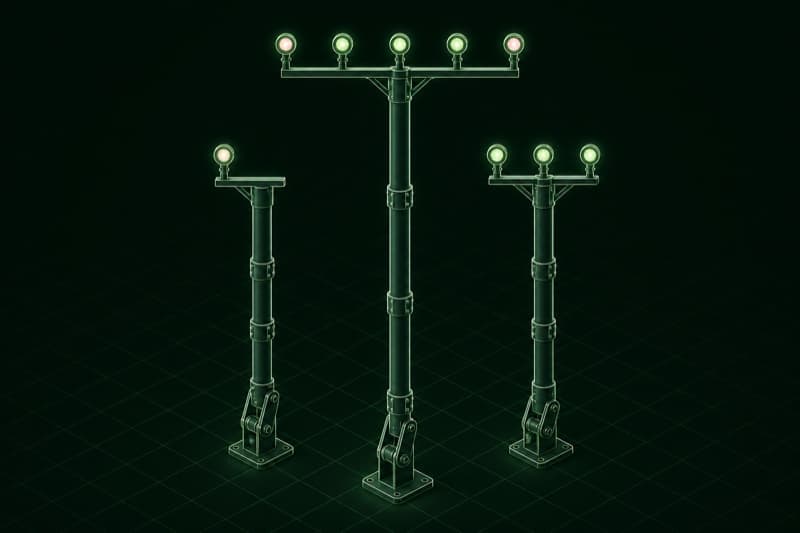
Frangible masts are the low-mass, low-strength support structures required under ICAO Annex 14 and FAA guidance for any fixture, wind cone, light, or antenna sited within a runway, taxiway, or helipad obstacle-limitation surface, designed to break away on aircraft impact rather than cause structural damage. NLS supplies frangible masts sized and coupled to the fixture and site loading they support.

Illuminated Wind Cones
Illuminated wind cones give pilots a visual read on wind direction and relative speed during night operations and low-light approach, mounted on a frangible mast with an internal or external light source. NLS supplies and installs illuminated wind cones engineered to ICAO Annex 14 and FAA AC 150/5345 series requirements, for airports, heliports, and helidecks across Saudi Arabia.

Solar Wind Cones
Solar wind cones combine a standard ICAO-compliant wind indicator with an independent photovoltaic power system, giving remote airfields, helipads, and heliports functioning night wind indication without a grid connection. NLS supplies and installs solar wind cone systems sourced from established international aviation lighting OEMs, sized to KSA solar conditions and matched to the site's obstacle-limitation and frangibility requirements.
Guides
Helipad Lighting Requirements: Perimeter, Floodlighting, Beacons and Wind Cones Under ICAO
What ICAO Annex 14 Volume II and GACAR Part 138 expect from helipad lighting, covering perimeter lights, floodlighting, heliport beacons and illuminated wind cones, explained qualitatively without invented specification values.
How Heliport Approval Works in Saudi Arabia Under GACAR Part 138
How GACAR Part 138 heliport approval works in Saudi Arabia: who applies, what an aeronautical study covers, the forms involved, and the typical gates a project moves through before an operator can use a helipad.
GACA Heliport Approval: What Building Owners Should Expect
What a building owner should expect from the GACA heliport approval journey under GACAR Part 138: who applies, the aeronautical study, documentation, inspection, and what makes approvals stall.
What a Hospital Helipad in Saudi Arabia Actually Needs
What a Saudi hospital helipad needs to comply with GACAR Part 138: siting logic, how TLOF and FATO sizing is actually determined, lighting and marking basis, firefighting provision, and the approval path from aeronautical study to operation.