
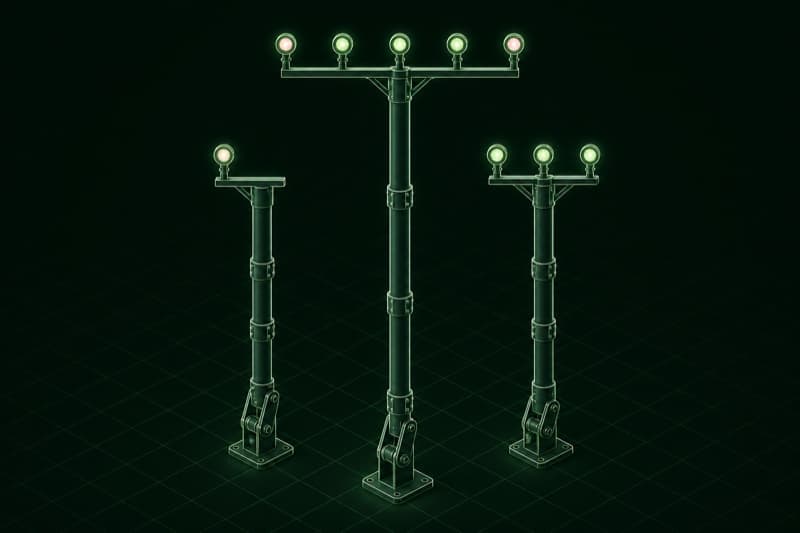
Frangible Masts
Frangible masts are the low-mass, low-strength support structures required under ICAO Annex 14 and FAA guidance for any fixture, wind cone, light, or antenna sited within a runway, taxiway, or helipad obstacle-limitation surface, designed to break away on aircraft impact rather than cause structural damage. NLS supplies frangible masts sized and coupled to the fixture and site loading they support.
Inside the Frangible Masts
A frangible mast is the structural support common to airfield and heliport wind indicators, lights, and antennas sited where an aircraft or vehicle could strike them. The tube, its engineered break point, and the base flange are designed together so the mast holds its fixture rigidly in service yet yields at a predictable, low-energy break rather than resisting impact.

01
Mast Tube
The main structural column, in a lightweight frangible material, that carries the wind indicator, light, or antenna at the required height above ground.

02
Frangible Coupling Point
An engineered break section, at low level, that shears cleanly under a defined impact load so the mast collapses instead of stopping an aircraft or vehicle.

03
Base Flange and Foundation Anchor
Fixes the mast to its foundation below the frangible coupling point, so the anchor itself stays intact and only the mast above it gives way on impact.

04
Internal Cable Conduit
Routes power or signal cabling up through the mast to the top-mounted fixture, keeping wiring protected from weather and out of view along the shaft.

05
Top Mounting Adapter
The fitting at the mast head that accepts the wind indicator, light fixture, or antenna, standardizing the top connection across different equipment types on the same mast design.
FULLY ASSEMBLED
Frangible Masts


| Function | Structural support for wind indicators, obstruction lights, and antennas in aircraft movement areas |
| Break behavior | Yields at a defined low-energy break point, frangibility requirement for objects near movement areas |
| Material | Lightweight frangible tube construction (composite or engineered aluminum) |
| Cabling | Internal conduit for power or signal cable to the top-mounted fixture |
| Mounting | Base flange anchored below the frangible break point |
| Compatible fixtures | Wind cones, obstruction lights, and low-profile antennas via a standardized top adapter |
Why frangibility is a structural requirement, not a preference
Any fixed structure inside an obstacle-limitation surface near a runway, taxiway, or helipad approach and takeoff path represents a collision risk to an aircraft that departs its intended path. ICAO Annex 14 and equivalent FAA guidance require that such structures be frangible: engineered to break, distort, or yield at a defined load well below what would seriously damage an aircraft, rather than standing rigid. This applies to wind cone masts, but equally to airfield ground lighting fixtures, approach lighting towers, antennas, and signage mounted within those surfaces.
Design principles
A frangible mast achieves its failure characteristic through material choice, a designed weak point (commonly a frangible coupling at the base), and controlled mass distribution, not by being flimsy in normal service. It still has to withstand routine wind loading, its own fixture's weight, and, in Saudi Arabia, sustained high temperatures and blowing sand, while yielding predictably under the specific impact load the standard defines. Getting this balance wrong in either direction, too rigid or too weak for daily conditions, is a design fault, not a tolerance issue.
Where frangible masts are required
NLS specifies frangible masts wherever a fixture sits within a runway strip, taxiway strip, or helipad's obstacle-limitation surface: wind cone supports, AGL fixture poles on outer sections of a lighting circuit, approach lighting structures, and any instrumentation or signage mount in the same zone. Sites entirely outside these surfaces do not require frangibility, and NLS assesses each mounting location against the governing obstacle-limitation surface rather than defaulting every mast to frangible construction regardless of position.
Supply and installation as part of the wider package
Frangible masts are rarely a standalone purchase. NLS supplies and installs them as part of wind indicator systems, AGL projects, obstruction lighting packages, and heliport lighting scopes, from established international aviation lighting OEMs, coordinated with the fixture they carry and the foundation design for the specific ground conditions on site. This keeps mast, coupling, and fixture matched to one another rather than sourced independently and reconciled on site.
Inspection and replacement
A frangible coupling's failure point can be affected by corrosion, incorrect torque during reinstallation after maintenance, or accumulated vibration damage over years of service, any of which can shift its actual break threshold away from design intent. NLS includes frangible mast and coupling inspection within its airfield and heliport lighting maintenance contracts, so the structural behavior that matters in an impact event is checked on a schedule, not assumed.
Specifications
- ✓Designed to ICAO Annex 14 and FAA frangibility requirements for obstacle-limitation surfaces
- ✓Frangible coupling at base engineered to a defined controlled failure load
- ✓Suited to wind cones, AGL poles, approach lighting structures and signage mounts
- ✓Materials and foundation specified for high-temperature, high-dust desert conditions
- ✓Coordinated sizing to the specific fixture weight and wind loading it carries
- ✓Available as standalone supply or within wind indicator, AGL and heliport lighting packages
Frequently Asked Questions
When is a frangible mast required by regulation?+
Whenever a fixed structure sits within a runway, taxiway, or helipad obstacle-limitation surface, ICAO Annex 14 and equivalent FAA guidance require it to be frangible so it breaks away safely rather than remaining rigid on aircraft impact.
Does a frangible mast need to survive normal wind loading?+
Yes. A frangible mast has to withstand routine site wind and fixture loading through its service life and only yield at the specific impact load defined by the governing standard, it is engineered, not simply weak.
Can NLS supply frangible masts on their own, without a full lighting package?+
Yes, though most projects specify them alongside the wind cone, AGL fixture, or lighting structure they support, since coupling and foundation are matched to that specific fixture.
What is the role of the Mast Tube in Frangible Masts?+
The main structural column, in a lightweight frangible material, that carries the wind indicator, light, or antenna at the required height above ground.
What is the role of the Frangible Coupling Point in Frangible Masts?+
An engineered break section, at low level, that shears cleanly under a defined impact load so the mast collapses instead of stopping an aircraft or vehicle.
What is the role of the Base Flange and Foundation Anchor in Frangible Masts?+
Fixes the mast to its foundation below the frangible coupling point, so the anchor itself stays intact and only the mast above it gives way on impact.
What is the role of the Internal Cable Conduit in Frangible Masts?+
Routes power or signal cabling up through the mast to the top-mounted fixture, keeping wiring protected from weather and out of view along the shaft.
What is the role of the Top Mounting Adapter in Frangible Masts?+
The fitting at the mast head that accepts the wind indicator, light fixture, or antenna, standardizing the top connection across different equipment types on the same mast design.
Who supplies Frangible Masts in Saudi Arabia?+
Northlane Solutions (Northlane Solutions Company) supplies Frangible Masts across Saudi Arabia, including Riyadh, Jeddah, Dammam and Jubail. Send your specification and quantities to info@northlanesolution.com for a quotation.
Related products

Illuminated Wind Cones
Illuminated wind cones give pilots a visual read on wind direction and relative speed during night operations and low-light approach, mounted on a frangible mast with an internal or external light source. NLS supplies and installs illuminated wind cones engineered to ICAO Annex 14 and FAA AC 150/5345 series requirements, for airports, heliports, and helidecks across Saudi Arabia.

Solar Wind Cones
Solar wind cones combine a standard ICAO-compliant wind indicator with an independent photovoltaic power system, giving remote airfields, helipads, and heliports functioning night wind indication without a grid connection. NLS supplies and installs solar wind cone systems sourced from established international aviation lighting OEMs, sized to KSA solar conditions and matched to the site's obstacle-limitation and frangibility requirements.

Heliport Wind Cones
Heliport wind cones are sized and positioned to the wind indicator requirements in ICAO Doc 9261 and CAP 437 for helidecks, giving helicopter pilots a clear read on surface wind during approach, hover, and departure at rooftop, ground-level, and offshore-style heliports. NLS supplies and installs heliport wind cones as part of turnkey heliport lighting and marking packages.
Guides
Helipad Lighting Requirements: Perimeter, Floodlighting, Beacons and Wind Cones Under ICAO
What ICAO Annex 14 Volume II and GACAR Part 138 expect from helipad lighting, covering perimeter lights, floodlighting, heliport beacons and illuminated wind cones, explained qualitatively without invented specification values.
Obstruction Light Types in Saudi Arabia: Low, Medium and High Intensity Explained
How to choose between low, medium and high intensity obstruction lights for towers, cranes and tall buildings in Saudi Arabia, day and night modes, and when each type applies under ICAO Annex 14.