
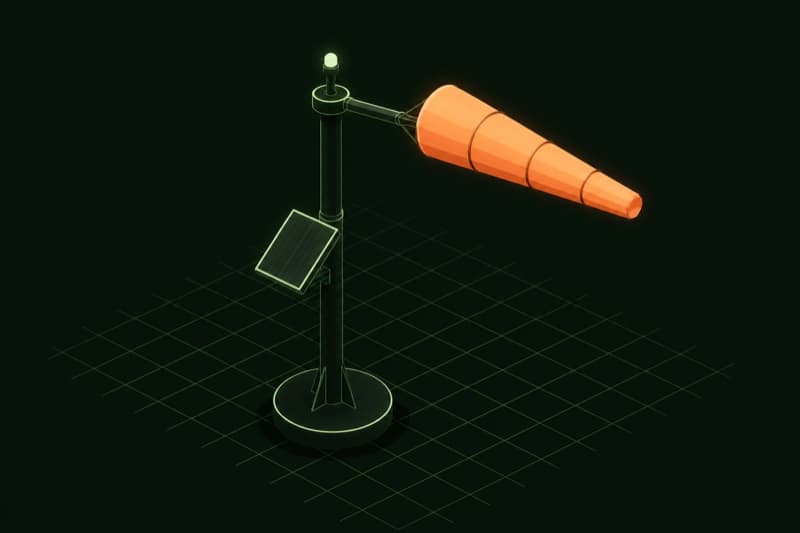
Solar Wind Cones (Windsocks)
Also called: solar windsock, solar powered wind sock, solar wind direction indicator
Solar wind cones combine a standard ICAO-compliant wind indicator with an independent photovoltaic power system, giving remote airfields, helipads, and heliports functioning night wind indication without a grid connection. NLS supplies and installs solar wind cone systems sourced from established international aviation lighting OEMs, sized to KSA solar conditions and matched to the site's obstacle-limitation and frangibility requirements.
Inside the Solar Wind Cones
A solar wind cone combines the standard fabric cone and swivel head of an ICAO-compliant wind indicator with a self-contained photovoltaic power supply, so the assembly gives usable night wind indication without a grid connection. The panel and battery unit feed an internal light source through the same mast that carries the wind sensing frame.

01
Windsock Fabric Cone
The tapered high-visibility fabric sleeve that fills and orients with the wind, giving pilots a direct visual read of wind direction and an approximate speed indication from its angle of inclination.

02
Frame and Swivel Head
The metal hoop that holds the cone open at its mouth, mounted on a low-friction swivel so the whole assembly rotates freely to face the wind from any direction.

03
Photovoltaic Panel
Mounted at the mast head or on a fixed bracket, it charges the system's battery through daylight hours, sized against KSA solar irradiance so the unit runs through the night without external power.

04
Battery and Charge Controller Enclosure
A weatherproof enclosure holding the battery bank and the charge controller that regulates panel input and battery discharge, protecting the stored energy that keeps the indicator lit overnight.

05
Internal Illumination Ring
A low-power LED ring inside the frame that lights the cone from within after dark, keeping the wind indication visible at night off the same power budget as the solar system.

06
Mast and Frangible Base
Supports the swivel head, panel, and battery enclosure at the required height above ground, coupled to a frangible base so the whole assembly gives way safely if struck.
FULLY ASSEMBLED
Solar Wind Cones


| Power source | Self-contained photovoltaic panel and battery bank, no grid connection required |
| Night operation | Internal LED illumination sized against the site's battery reserve |
| Sizing basis | Panel and battery capacity matched to KSA solar irradiance conditions |
| Mounting | Frangible mast base, self-supporting |
| Cone material | High-visibility fabric, colored per applicable aviation marking convention |
| Typical siting | Remote or off-grid airfields, helipads, and heliports |
Where grid power is not available
Many helipads, remote strips, and staging airfields in Saudi Arabia sit well outside reach of a stable low-voltage feed. A wind cone at those sites still needs to function at night if the site supports any low-light or emergency operation, and running a dedicated mains cable to a single fixture is rarely justified on cost or schedule grounds. A self-contained solar wind cone solves that without compromising on the visual standard a pilot expects.
System design
A solar wind cone pairs the standard ICAO Annex 14 orange and white segmented cone with a photovoltaic panel, charge controller, deep-cycle battery, and an LED illumination source, all mounted on or adjacent to the frangible mast. NLS sizes the panel and battery bank against Saudi Arabia's solar irradiance profile with margin for consecutive low-sun days, and specifies photocell-based dusk-to-dawn switching so the unit requires no manual operation once commissioned. Enclosures and cabling are specified for high-temperature, high-dust desert conditions rather than a generic off-the-shelf rating.
Standards compliance
The cone itself, its dimensions, color pattern, and mounting height, follows the same ICAO Annex 14 Volume I and FAA AC 150/5345 series criteria as a mains-fed unit. Using solar power changes the energy source, not the visual or structural standard the fixture has to meet. The mast remains frangible wherever the unit falls within a runway, taxiway, or helipad obstacle-limitation surface.
Turnkey delivery
NLS handles solar wind cone projects end to end: site solar assessment, procurement from established international aviation lighting OEMs, civil works for the mast foundation, electrical assembly of the panel-battery-controller system, and commissioning verification of the dusk-to-dawn switching and cone illumination. This is delivered as one scope with a single point of accountability, priced in USD or SAR, rather than a fixture bought separately from its installation.
Ongoing performance
Battery capacity and panel output both degrade over years of desert exposure, and a solar wind cone that quietly stops illuminating at night is a compliance and safety gap that is easy to miss without a scheduled check. NLS includes solar wind cone system checks, battery testing, and panel cleaning within its airfield lighting maintenance contracts so remote fixtures are verified on a set interval rather than only when someone happens to notice.
Specifications
- ✓Photovoltaic panel, charge controller and deep-cycle battery sized to KSA solar conditions
- ✓Cone dimensions and color pattern conform to ICAO Annex 14 Volume I
- ✓Photocell-based dusk-to-dawn illumination switching, no manual operation required
- ✓Enclosures and cabling rated for high-temperature, high-dust desert exposure
- ✓Mounted on a frangible mast within runway, taxiway or helipad obstacle-limitation surfaces
- ✓No grid connection required, suited to remote and staging airfields
Frequently Asked Questions
Is a solar wind cone as reliable as a mains-powered one?+
When the panel and battery are sized correctly for the site's solar profile, a solar wind cone runs the same dusk-to-dawn cycle reliably, including through several consecutive overcast days.
Does a solar wind cone still need a frangible mast?+
Yes. The frangibility requirement is tied to the mast's position relative to obstacle-limitation surfaces, not to how the fixture is powered, so a solar unit within those surfaces still needs a frangible mount.
How often does a solar wind cone system need servicing?+
Battery health, panel cleanliness, and photocell switching should be checked on a scheduled interval as part of an airfield lighting maintenance contract, since a failing solar unit does not always show visible symptoms in daylight.
What is the role of the Windsock Fabric Cone in Solar Wind Cones?+
The tapered high-visibility fabric sleeve that fills and orients with the wind, giving pilots a direct visual read of wind direction and an approximate speed indication from its angle of inclination.
What is the role of the Frame and Swivel Head in Solar Wind Cones?+
The metal hoop that holds the cone open at its mouth, mounted on a low-friction swivel so the whole assembly rotates freely to face the wind from any direction.
What is the role of the Photovoltaic Panel in Solar Wind Cones?+
Mounted at the mast head or on a fixed bracket, it charges the system's battery through daylight hours, sized against KSA solar irradiance so the unit runs through the night without external power.
What is the role of the Battery and Charge Controller Enclosure in Solar Wind Cones?+
A weatherproof enclosure holding the battery bank and the charge controller that regulates panel input and battery discharge, protecting the stored energy that keeps the indicator lit overnight.
What is the role of the Internal Illumination Ring in Solar Wind Cones?+
A low-power LED ring inside the frame that lights the cone from within after dark, keeping the wind indication visible at night off the same power budget as the solar system.
What is the role of the Mast and Frangible Base in Solar Wind Cones?+
Supports the swivel head, panel, and battery enclosure at the required height above ground, coupled to a frangible base so the whole assembly gives way safely if struck.
Who supplies Solar Wind Cones (Windsocks) in Saudi Arabia?+
Northlane Solutions (Northlane Solutions Company) supplies Solar Wind Cones (Windsocks) across Saudi Arabia, including Riyadh, Jeddah, Dammam and Jubail. Send your specification and quantities to info@northlanesolution.com for a quotation.
Related products
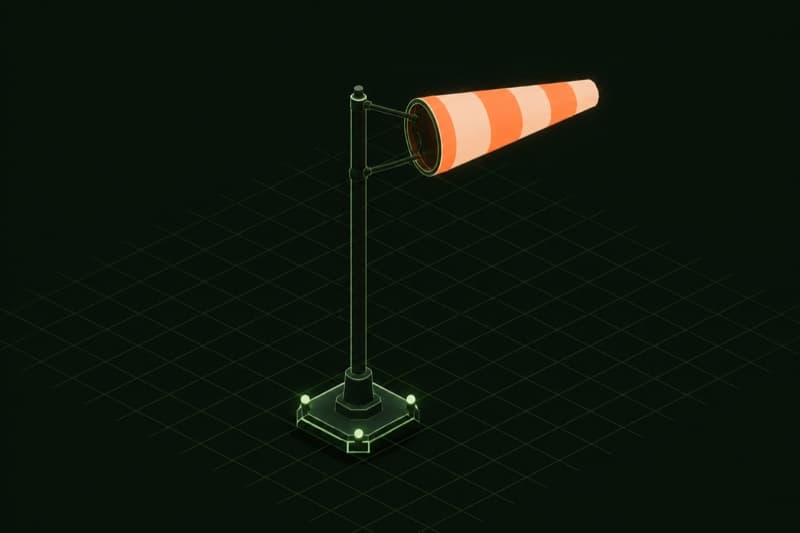
Heliport Wind Cones
Heliport wind cones are sized and positioned to the wind indicator requirements in ICAO Doc 9261 and CAP 437 for helidecks, giving helicopter pilots a clear read on surface wind during approach, hover, and departure at rooftop, ground-level, and offshore-style heliports. NLS supplies and installs heliport wind cones as part of turnkey heliport lighting and marking packages.
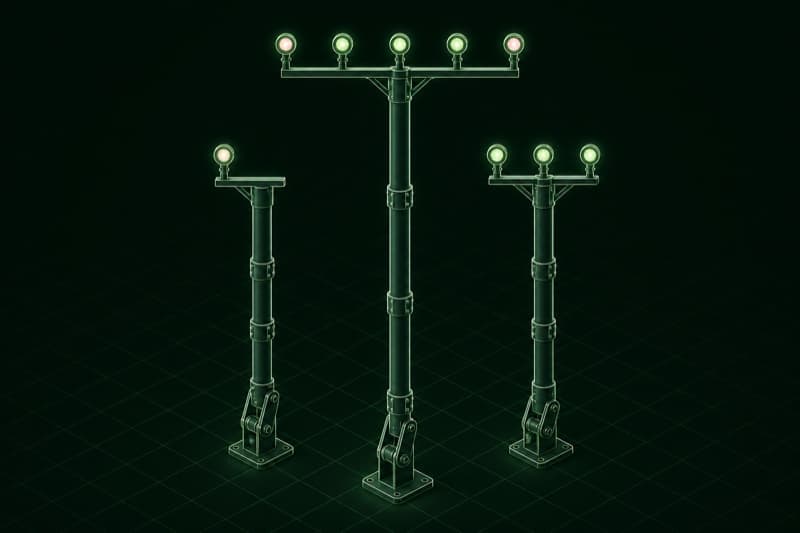
Frangible Masts
Frangible masts are the low-mass, low-strength support structures required under ICAO Annex 14 and FAA guidance for any fixture, wind cone, light, or antenna sited within a runway, taxiway, or helipad obstacle-limitation surface, designed to break away on aircraft impact rather than cause structural damage. NLS supplies frangible masts sized and coupled to the fixture and site loading they support.
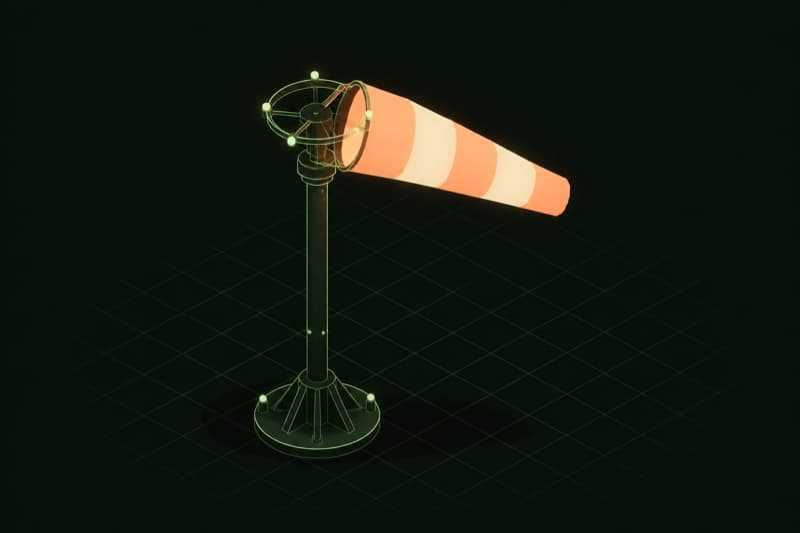
Illuminated Wind Cones
Illuminated wind cones give pilots a visual read on wind direction and relative speed during night operations and low-light approach, mounted on a frangible mast with an internal or external light source. NLS supplies and installs illuminated wind cones engineered to ICAO Annex 14 and FAA AC 150/5345 series requirements, for airports, heliports, and helidecks across Saudi Arabia.