
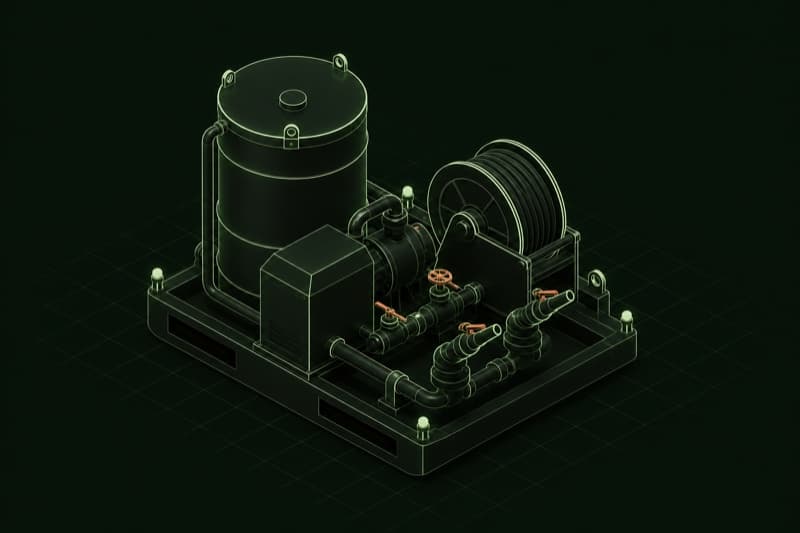
Heliport Firefighting Systems
Heliport firefighting systems supply the fixed or mobile foam and dry chemical equipment, plus the trained-response capability, that a helipad or heliport needs to meet its required aviation rescue and firefighting category under ICAO Doc 9261 and NFPA 418. NLS scopes, supplies, and installs heliport firefighting equipment, matched to a site's category and deck configuration.
Inside the Heliport Firefighting Systems
A heliport firefighting system supplies the extinguishing agent, delivery equipment and control gear that give a pad its required rescue and firefighting response. A fixed or mobile agent tank, its pump, discharge equipment and control panel work together to put suppression capability on the pad within the required response time.
01
Agent Storage Tank
Holds the foam concentrate or dry chemical agent at the volume the pad's required firefighting category calls for, sized and positioned for rapid access during a response.
02
Discharge Monitor
Directs the extinguishing agent onto the fire area, whether as a fixed monitor covering the touchdown area or a handline nozzle for a mobile unit, controlling the discharge pattern and range.
03
Pump Unit
Pressurises the agent from the storage tank through the discharge line at the flow rate and pressure the system design requires, sized to reach full output within the mandated response time.
04
Hose Reel Assembly
Stores and pays out the delivery hose so responders can reach any point on the pad without the agent line kinking or being caught underfoot during an emergency.
05
System Control Panel
Governs system activation, pump start and agent proportioning on fixed installations, and reports system status so the operator can confirm readiness before every flight operation.
| Agent type | Foam concentrate or dry chemical agent matched to the pad's required firefighting category |
| System configuration | Fixed pad-mounted system or mobile trolley and vehicle-based units, per the site's response plan |
| Response readiness | Sized and positioned to reach the required agent discharge within the mandated response time |
| Discharge control | Manual actuation with monitor or handline delivery, with automatic proportioning on fixed installations |
| Body material class | Corrosion resistant tank and fitting materials suited to standing agent storage and outdoor exposure |
| Operating environment | Engineered for outdoor heliport standby duty across the Kingdom's temperature and dust conditions |
A heliport's firefighting provision is sized to a required rescue and firefighting category, not a single fixed equipment list, with the category driven by the largest helicopter type the deck is designed to serve and the deck's location type: an elevated helideck on a hospital rooftop, an offshore or coastal platform deck, and a ground-level industrial pad each carry a different practical equipment and response arrangement even where the underlying category calculation follows the same ICAO Doc 9261 method. NFPA 418, the US standard widely referenced alongside ICAO guidance for heliport firefighting equipment and installation, sets out the extinguishing agent quantities, discharge rates, and application method a compliant system has to deliver for helicopter fires specifically, a different fire behaviour and fuel load profile than fixed-wing aircraft firefighting is designed around.
The equipment scope typically combines a foam proportioning and discharge system, whether a fixed monitor system on a larger or higher-category deck or portable foam and dry chemical extinguishers sized to the category on a smaller or lower-traffic pad, dry chemical extinguishers for engine and electrical fires foam alone doesn't address well, and in some configurations a dedicated firefighting water supply or foam concentrate storage sized to the discharge duration the category requires. Getting the agent type, quantity, and discharge rate right against the actual category, rather than a generic firefighting equipment package, is the core of a compliant heliport firefighting scope.
NLS scopes heliport firefighting provision against the specific category a deck's helicopter type and location require, sources the foam and dry chemical equipment from established manufacturers, and coordinates installation of fixed systems where the category calls for them, alongside the portable equipment and signage a smaller deck needs. This sits alongside NLS's wider helideck delivery, lighting, marking, and civil works, so a project can scope firefighting provision as part of one coordinated heliport package rather than as a separate procurement thread.
Saudi hospital rooftop helidecks and industrial site pads carry two practical considerations beyond the base category calculation: response time from the equipment location to the deck matters as much as the equipment itself, so equipment siting and the trained-responder arrangement need checking against the deck's actual layout and the facility's existing fire response capability rather than assumed compliant by default, and foam concentrate and dry chemical agents have shelf life and storage temperature limits that Saudi ambient heat pushes harder on than a temperate-climate storage assumption, worth building into the site's maintenance and replacement schedule from commissioning onward.
NLS delivers heliport firefighting provision as a scoped, supplied, and installed package, matched to the site's required category and location type, sourced from established manufacturers, priced in USD for supply and SAR for the customer-facing offer. A project team typically shares the deck's helicopter type, location classification, and any existing site fire response capability, and NLS returns a category determination and equipment recommendation with a matched quote.
Specifications
- ✓Required rescue and firefighting category determined per ICAO Doc 9261 methodology, driven by helicopter type and deck location classification
- ✓Extinguishing agent quantities, discharge rates, and application method to NFPA 418 for helicopter fire scenarios
- ✓Fixed foam monitor systems for larger/higher-category decks, portable foam and dry chemical extinguishers for smaller decks
- ✓Dry chemical provision for engine and electrical fires alongside foam agent
- ✓Foam concentrate and dry chemical storage sized and rated for Saudi ambient heat and shelf-life limits
- ✓Equipment siting and response-time review against the deck's actual layout and facility fire response capability
Frequently Asked Questions
What determines the firefighting category a heliport needs?+
The category is calculated under ICAO Doc 9261 methodology, driven mainly by the largest helicopter type the deck is designed to serve and the deck's location classification. It is not a single fixed requirement across all heliports.
Does a hospital rooftop helideck need fixed firefighting equipment?+
It depends on the required category, which follows from the helicopter type served and the deck's classification. Some hospital rooftop decks meet their category with portable foam and dry chemical equipment, while others require a fixed monitor system. NLS determines this from the specific site data before recommending equipment.
Who supplies heliport firefighting equipment in Saudi Arabia?+
NLS scopes the required category under ICAO Doc 9261 and NFPA 418, then sources and installs matched foam and dry chemical firefighting equipment turnkey, for helipad and heliport projects across the Kingdom.
What is the role of the Agent Storage Tank in Heliport Firefighting Systems?+
Holds the foam concentrate or dry chemical agent at the volume the pad's required firefighting category calls for, sized and positioned for rapid access during a response.
What is the role of the Discharge Monitor in Heliport Firefighting Systems?+
Directs the extinguishing agent onto the fire area, whether as a fixed monitor covering the touchdown area or a handline nozzle for a mobile unit, controlling the discharge pattern and range.
What is the role of the Pump Unit in Heliport Firefighting Systems?+
Pressurises the agent from the storage tank through the discharge line at the flow rate and pressure the system design requires, sized to reach full output within the mandated response time.
What is the role of the Hose Reel Assembly in Heliport Firefighting Systems?+
Stores and pays out the delivery hose so responders can reach any point on the pad without the agent line kinking or being caught underfoot during an emergency.
What is the role of the System Control Panel in Heliport Firefighting Systems?+
Governs system activation, pump start and agent proportioning on fixed installations, and reports system status so the operator can confirm readiness before every flight operation.
Who supplies Heliport Firefighting Systems in Saudi Arabia?+
Northlane Solutions (Northlane Solutions Company) supplies Heliport Firefighting Systems across Saudi Arabia, including Riyadh, Jeddah, Dammam and Jubail. Send your specification and quantities to info@northlanesolution.com for a quotation.
Related products

Heliport Marking Services
Heliport marking services paint and apply the TLOF and FATO boundary lines, the H identification marking, the maximum weight figure, and approach and wind direction markings a helipad needs, engineered to ICAO Annex 14 Volume II and GACAR Part 138 dimensions, tolerances, and colours. NLS delivers heliport marking, survey through application and inspection, across Saudi Arabia.

TLOF Perimeter Lights
TLOF perimeter lights are the fixed green fixtures that outline the touchdown and lift-off area of a helipad or heliport so a pilot can identify its edges and orientation at night or in low visibility. NLS sources and installs TLOF perimeter lighting engineered to ICAO Annex 14 Volume II and GACAR Part 138 across Saudi Arabia.

Heliport Floodlights
Heliport floodlights illuminate the touchdown and lift-off area, apron, and approach surface of a helipad broadly enough for a pilot to judge the deck surface and any surrounding obstacles during a night approach, working alongside perimeter and marking lights. NLS sources and installs heliport floodlighting engineered to ICAO Annex 14 Volume II for helipad and heliport projects in Saudi Arabia.

Heliport Beacons
Heliport beacons are the flashing identification lights that mark a heliport's location from a distance so an approaching pilot can find the site before the TLOF area and detailed markings become visible. NLS supplies beacons whose flash signature matches the standard the site is approved under, ICAO Annex 14 Volume II for a heliport designed to the ICAO framework.
Helideck Status Lights
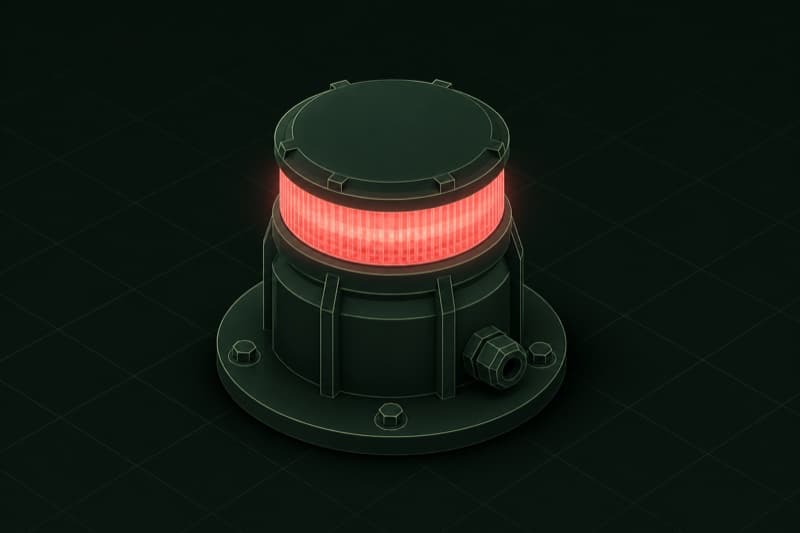
Helideck status lighting signals to an approaching pilot whether a deck is available, with a flashing red state indicating the deck is unsafe to land, controlled from the deck operator's station under CAP 437. NLS sources and installs helideck status lighting for helideck and heliport projects in Saudi Arabia.
Guides
What a Hospital Helipad in Saudi Arabia Actually Needs
What a Saudi hospital helipad needs to comply with GACAR Part 138: siting logic, how TLOF and FATO sizing is actually determined, lighting and marking basis, firefighting provision, and the approval path from aeronautical study to operation.
What Actually Drives Helipad Construction Cost in Saudi Arabia
The real cost drivers behind helipad construction in Saudi Arabia: site type, structure and civil works, lighting and firefighting scope, GACA approval, and location logistics.