
Posted on 2026-06-06
What Actually Drives Helipad Construction Cost in Saudi Arabia
Ask what a helipad costs and the honest answer is that the question is incomplete. A ground-level helipad on flat land at an industrial site and a rooftop helipad on a hospital tower in a dense city are different projects that happen to share a name. The gap between them is not finish quality. It comes from five factors that decide most of the number before anyone prices a single light fixture: site type, structure and civil works, the lighting and firefighting package, General Authority of Civil Aviation (GACA) approval scope, and how hard the site is to reach. Understanding these drivers matters more than chasing a headline figure, because the figure only means something once the site is defined.
Site type sets the baseline
A ground-level helipad built on a prepared, accessible plot is the simplest version of the project. The touchdown and lift-off area, the surrounding safety area, and the approach and departure paths sit on graded ground with straightforward access for equipment and materials. Most of the spend goes into pavement or surfacing, marking, lighting, and drainage, work that is well understood and repeatable.
An elevated helipad, built on a purpose-designed platform above ground level rather than on an existing rooftop, adds a structural layer the ground-level case does not have. Something now has to carry the load, resist wind, and meet the aeronautical siting requirements for approach and departure paths clear of obstacles. That structure is engineered and erected before the helipad surface itself is even a consideration.
A rooftop helipad, most commonly on a hospital, carries the elevated case's structural demands plus a second layer of constraints. The building underneath was not necessarily designed for helicopter operational loads, rooftop plant competes for space with the required safety areas, and the aeronautical study has to treat the surrounding skyline as an obstacle environment. Rooftop projects are consistently the most expensive of the three, not because the helipad itself is more elaborate, but because everything around it has to be resolved first.
Structure and civil works are the dominant line item
Across all three site types, structure and civil works, foundations, the load-bearing platform or pavement, and drainage, are typically the single largest component of total cost. This holds even for ground-level sites, where earthworks and surfacing to the tolerances a helicopter operation requires cost several times more than a comparable general-purpose hardstanding. For elevated and rooftop projects, structural steel or reinforced concrete design becomes the dominant driver, because the helipad has to be engineered as a load-bearing platform first and a landing surface second.
Lighting and firefighting are smaller but non-negotiable
The lighting package, perimeter lights, floodlighting, and any approach path indicators, along with firefighting and rescue provision, is a meaningfully smaller share of total cost than structure and civil works, but it is not where value engineering should happen. Lighting equipment specified against a named photometric and installation standard costs more upfront than generic fixtures, but it is what a design submission needs to clear GACA review without a resubmission cycle. Firefighting provision, sized to the aircraft category the helipad serves, follows the same logic. It is a fixed technical requirement, and trimming it usually costs more later in rework than it saves at tender.
GACA approval scope adds real, uneven cost
Helipad and heliport projects in Saudi Arabia are approved under GACAR Part 138, and design generally aligns with ICAO Annex 14 Volume II and, where relevant, FAA AC 150/5390-2 heliport design guidance. The approval process, the aeronautical study, the documentation package, design review, and final inspection, adds cost and time that scales with site complexity rather than size. A ground-level site with a clean obstacle environment moves through this relatively efficiently. A rooftop site in a dense urban area, where the aeronautical study works through a genuinely constrained approach and departure environment, can turn this into one of the more time-consuming parts of the project, even though it never shows up as a physical structure. Getting the study and design approval sequence settled before construction starts is what keeps this driver from compounding into rework, the most expensive way it shows up.
Location and logistics quietly move the number
The last driver is the one clients underestimate most: how hard it is to physically deliver the project. A helipad in an industrial zone with road access and laydown space is straightforward to mobilize for. A rooftop project in a congested city center, or a site in a remote region of the Kingdom far from the main supply corridors, adds cost through crane access, material hoisting, restricted working hours, and distance from where components are sourced. None of this changes the design. All of it changes the price, sometimes enough to change which site type looks more economical once logistics are priced in rather than assumed away.
Where this leaves a buyer
None of these five drivers prices honestly in isolation from the others. A ground-level site in an accessible location with a standard aeronautical study is a fundamentally different cost profile than a rooftop site in a dense city with a constrained obstacle environment, before the first lighting fixture is even specified. The way to get a realistic number is to fix the site type and location first, scope the structural and civil works against that specific site, and treat lighting, firefighting, and GACA approval scope as fixed requirements, not variables to negotiate down. Northlane Solutions supplies and installs lighting, marking, and obstruction infrastructure for helipad and heliport projects in Saudi Arabia, engineered to ICAO Annex 14 Volume II, with design submissions aligned to GACAR Part 138. Start from the Helipad & Heliport Solutions overview, then price the fixed items from TLOF Perimeter Lights and Heliport Firefighting Systems.
FAQ
Q: Why does a rooftop helipad cost more than a ground-level one in Saudi Arabia? A: A rooftop helipad carries structural reinforcement to the existing building, competition for space with rooftop plant, and a more constrained aeronautical study for the surrounding obstacle environment. None of that applies to a helipad built on prepared ground.
Q: What is the biggest cost driver in helipad construction? A: Structure and civil works, foundations, the load-bearing platform or pavement, and drainage, is typically the dominant line item across all site types, growing even larger for elevated and rooftop projects.
Q: Does GACA approval add significant cost to a helipad project? A: The approval process under GACAR Part 138 adds cost and time that scales with site complexity, and it is most costly when the aeronautical study and design approval are not settled before construction starts, since later changes force rework.
Q: Is lighting a major cost driver for a helipad? A: Lighting and firefighting are smaller than structure and civil works, but they are fixed requirements tied to recognized standards, not areas to reduce, since generic equipment without a stated compliance basis tends to surface as a problem at final inspection.
Related products

TLOF Perimeter Lights
TLOF perimeter lights are the fixed green fixtures that outline the touchdown and lift-off area of a helipad or heliport so a pilot can identify its edges and orientation at night or in low visibility. NLS sources and installs TLOF perimeter lighting engineered to ICAO Annex 14 Volume II and GACAR Part 138 across Saudi Arabia.
Heliport Firefighting Systems
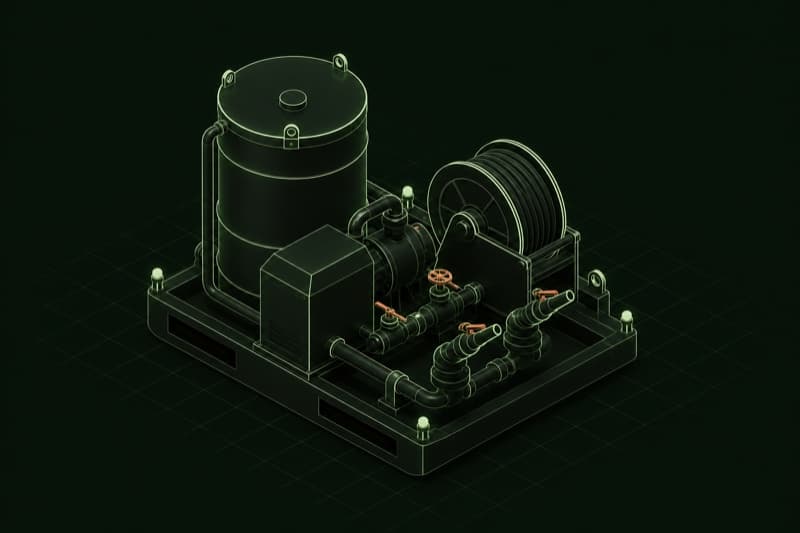
Heliport firefighting systems supply the fixed or mobile foam and dry chemical equipment, plus the trained-response capability, that a helipad or heliport needs to meet its required aviation rescue and firefighting category under ICAO Doc 9261 and NFPA 418. NLS scopes, supplies, and installs heliport firefighting equipment, matched to a site's category and deck configuration.

AGL Maintenance Contracts
AGL maintenance contracts cover the scheduled preventive checks and corrective repair response that keep runway, taxiway, and apron lighting circuits within ICAO Annex 14 and GACAR Part 139 serviceability limits between inspections. NLS structures these as a fixed scope of visits, fault response, and reporting, sized to the airfield's fixture count and circuit layout.

Heliport Floodlights
Heliport floodlights illuminate the touchdown and lift-off area, apron, and approach surface of a helipad broadly enough for a pilot to judge the deck surface and any surrounding obstacles during a night approach, working alongside perimeter and marking lights. NLS sources and installs heliport floodlighting engineered to ICAO Annex 14 Volume II for helipad and heliport projects in Saudi Arabia.