
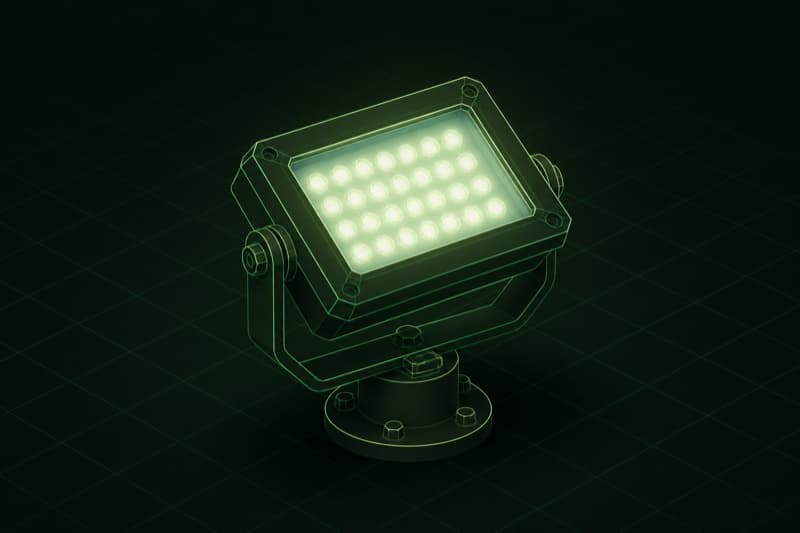
Heliport Floodlights
Heliport floodlights illuminate the touchdown and lift-off area, apron, and approach surface of a helipad broadly enough for a pilot to judge the deck surface and any surrounding obstacles during a night approach, working alongside perimeter and marking lights. NLS sources and installs heliport floodlighting engineered to ICAO Annex 14 Volume II for helipad and heliport projects in Saudi Arabia.
Inside the Heliport Floodlights
A heliport floodlight assembly provides the general area illumination that lets a pilot read the touchdown and lift-off surface, apron, and approach path during a night landing, working alongside perimeter and marking lights rather than replacing them. The fixture, mounting, and photometric control elements work together to light the deck evenly without glaring back at the pilot on approach.
01
LED Optical Assembly
The light source and lens or reflector array that shapes the beam spread and intensity, engineered to spread light evenly across the touchdown and lift-off area while limiting output in directions that could dazzle a pilot on final approach.
02
Glare Shield and Beam Cutoff
A shielding hood or louvre fitted over the fixture that cuts off stray light above a set angle, the feature that separates safe heliport floodlighting from a fixture that simply throws light at the deck.
03
Mounting Bracket and Aiming Adjustment
Fixes the fixture to the pad edge, perimeter structure, or adjacent building and allows the beam angle to be set and locked during commissioning to match the specific approach geometry of the heliport.
04
Weatherproof Housing
The sealed enclosure protecting the LED module and driver electronics from dust, moisture, and temperature extremes, built to withstand continuous outdoor exposure at an operational heliport.
05
Driver and Control Gear
Regulates power to the LED array and interfaces with the airfield lighting control system for switching and, where fitted, intensity stepping between day and night operating levels.
| Function | General area illumination of touchdown, lift-off area, and apron |
| Light source | LED |
| Beam control | Shielded, glare limited toward the approach path |
| Mounting | Pad edge, perimeter structure, or adjacent building, angle adjustable |
| Housing rating | Weatherproof for continuous outdoor exposure |
| Control interface | Integrates with airfield lighting control system |
Heliport floodlighting provides the general area illumination that lets a pilot read the touchdown and lift-off surface, judge the apron, and see the immediate approach path clearly during a night landing, a different function from the pinpoint marker lighting on the perimeter or the aiming lights that define the approach direction. Floodlights sit around the edge of the pad or on adjacent structures, angled and shielded so the beam lights the deck surface without glaring back into the pilot's eyes on approach, a balance that's harder to get right on a small helideck than on a large apron where fixtures sit much further from the flight path.
ICAO Annex 14 Volume II gives the reference for the general illumination level a heliport lighting scheme needs to achieve, and the practical design work sits in fixture placement, beam angle, and glare control rather than raw lumen output alone. A floodlight aimed without care for a pilot's eye height on final approach can do more harm than a dimmer, better-placed fixture, which is why heliport floodlighting is engineered as a coordinated scheme against the pad geometry rather than specified as a generic wattage per square meter.
NLS treats heliport floodlighting as part of the same specialism as TLOF perimeter and approach lighting rather than a lighting category borrowed from general facility work. Fixtures are sourced to IEC 60598 luminaire safety standards, in LED format for instant-on performance and lower power draw than the metal halide floodlights still found on older heliport installations, and matched to the mounting arrangement a site allows, whether that's pad-perimeter poles, adjacent building parapets on a rooftop helideck, or dedicated structure on a ground-level pad.
Saudi conditions push two factors into the floodlight selection beyond the base photometric design. Dust accumulation on a floodlight lens reduces effective output faster in the Kingdom's outdoor environment than most maintenance intervals assume, worth planning into the lighting scheme's maintenance factor rather than discovering it after commissioning, and rooftop-mounted floodlights on an elevated helideck need a housing and mounting bracket rated for the wind loading that elevated structure sees, distinct from the wind exposure a ground-level pad experiences.
NLS delivers heliport floodlighting as part of a turnkey helipad package, design, supply, installation, and commissioning under one desk, sourced from established international aviation lighting manufacturers, priced in USD for supply and SAR for the customer-facing offer. A project team typically shares the pad layout and mounting constraints (rooftop, ground-level, adjacent structure availability), and NLS returns a fixture and layout recommendation with a matched quote.
Specifications
- ✓General illumination scheme referenced to ICAO Annex 14 Volume II, engineered against pad geometry rather than a fixed wattage per area
- ✓LED floodlight fixtures to IEC 60598 luminaire safety, replacing metal halide units in older installations
- ✓Beam angle and glare shielding designed for pilot eye-height on final approach
- ✓Mounting options: pad-perimeter poles, adjacent structure or parapet, or dedicated rooftop bracket
- ✓Wind-rated mounting brackets for elevated helideck installations
- ✓IP-rated housings for outdoor dust and sand exposure on Saudi sites
Frequently Asked Questions
Do heliport floodlights replace perimeter and approach lighting?+
No. Floodlighting provides general area illumination of the pad surface and apron, while perimeter and approach lighting mark the deck boundary and guide the approach path. A heliport lighting scheme runs all three together, not one in place of the others.
Who supplies heliport floodlighting in Saudi Arabia?+
NLS sources LED heliport floodlights engineered to ICAO Annex 14 Volume II and delivers them turnkey, design, supply, installation, and commissioning, for helipad and heliport projects across the Kingdom.
Why does floodlight glare matter more on a helipad than a large airport apron?+
A helicopter's final approach path passes much closer to floodlight fixtures than a fixed-wing aircraft's does on a large apron, so a poorly angled or unshielded floodlight can glare directly into a pilot's eyes at a critical point in the approach. NLS designs beam angle and shielding against the pad's specific approach geometry rather than a generic floodlight spec.
What is the role of the LED Optical Assembly in Heliport Floodlights?+
The light source and lens or reflector array that shapes the beam spread and intensity, engineered to spread light evenly across the touchdown and lift-off area while limiting output in directions that could dazzle a pilot on final approach.
What is the role of the Glare Shield and Beam Cutoff in Heliport Floodlights?+
A shielding hood or louvre fitted over the fixture that cuts off stray light above a set angle, the feature that separates safe heliport floodlighting from a fixture that simply throws light at the deck.
What is the role of the Mounting Bracket and Aiming Adjustment in Heliport Floodlights?+
Fixes the fixture to the pad edge, perimeter structure, or adjacent building and allows the beam angle to be set and locked during commissioning to match the specific approach geometry of the heliport.
What is the role of the Weatherproof Housing in Heliport Floodlights?+
The sealed enclosure protecting the LED module and driver electronics from dust, moisture, and temperature extremes, built to withstand continuous outdoor exposure at an operational heliport.
What is the role of the Driver and Control Gear in Heliport Floodlights?+
Regulates power to the LED array and interfaces with the airfield lighting control system for switching and, where fitted, intensity stepping between day and night operating levels.
Who supplies Heliport Floodlights in Saudi Arabia?+
Northlane Solutions (Northlane Solutions Company) supplies Heliport Floodlights across Saudi Arabia, including Riyadh, Jeddah, Dammam and Jubail. Send your specification and quantities to info@northlanesolution.com for a quotation.
Related products

Heliport Beacons
Heliport beacons are the flashing identification lights that mark a heliport's location from a distance so an approaching pilot can find the site before the TLOF area and detailed markings become visible. NLS supplies beacons whose flash signature matches the standard the site is approved under, ICAO Annex 14 Volume II for a heliport designed to the ICAO framework.

Helideck Status Lights
Helideck status lighting signals to an approaching pilot whether a deck is available, with a flashing red state indicating the deck is unsafe to land, controlled from the deck operator's station under CAP 437. NLS sources and installs helideck status lighting for helideck and heliport projects in Saudi Arabia.
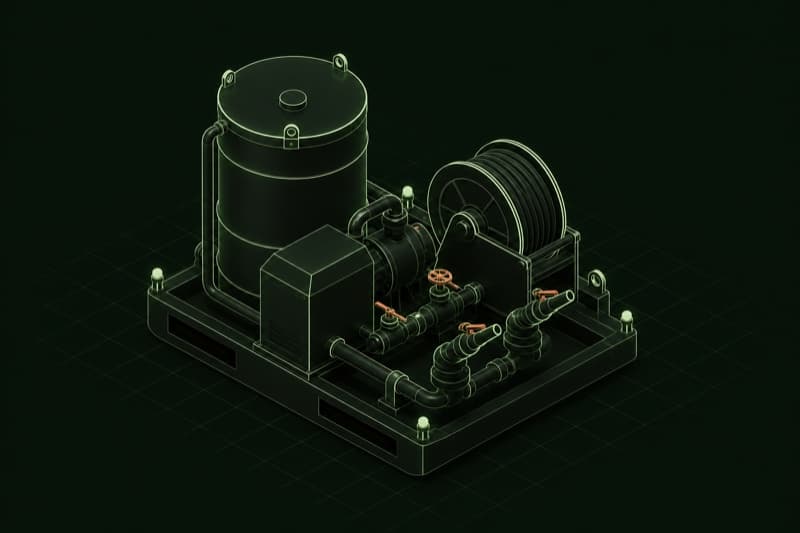
Heliport Firefighting Systems
Heliport firefighting systems supply the fixed or mobile foam and dry chemical equipment, plus the trained-response capability, that a helipad or heliport needs to meet its required aviation rescue and firefighting category under ICAO Doc 9261 and NFPA 418. NLS scopes, supplies, and installs heliport firefighting equipment, matched to a site's category and deck configuration.

Heliport Marking Services
Heliport marking services paint and apply the TLOF and FATO boundary lines, the H identification marking, the maximum weight figure, and approach and wind direction markings a helipad needs, engineered to ICAO Annex 14 Volume II and GACAR Part 138 dimensions, tolerances, and colours. NLS delivers heliport marking, survey through application and inspection, across Saudi Arabia.

TLOF Perimeter Lights
TLOF perimeter lights are the fixed green fixtures that outline the touchdown and lift-off area of a helipad or heliport so a pilot can identify its edges and orientation at night or in low visibility. NLS sources and installs TLOF perimeter lighting engineered to ICAO Annex 14 Volume II and GACAR Part 138 across Saudi Arabia.