

Aircraft Warning Spheres
Aircraft warning spheres are large coloured marker balls fitted onto overhead power lines, cables and wires that cross valleys, rivers or approach paths, giving pilots a visible daytime warning where a solid structure light is impractical. NLS supplies and installs aircraft warning spheres across Saudi Arabia in orange, white or a combination pattern per ICAO Annex 14 marking requirements.
Inside the Aircraft Warning Spheres
An aircraft warning sphere assembly consists of the marker sphere itself, its internal support core and the suspension clamp that grips the overhead line, plus the counterweight and hardware that keep the sphere seated and level once installed. Fitted in series along a span, the spheres give an approaching pilot a visible daytime warning where a solid structure light is impractical.

01
Marker Sphere Shell
The visible orange, white or combination-pattern shell that gives the line its daytime conspicuity, moulded from lightweight weather resistant material so the sphere stays visible without adding excessive load to the span.

02
Internal Support Core
Forms the rigid structural centre the two shell halves close around, keeping the sphere's shape true under wind loading and the mechanical vibration of a live overhead conductor.

03
Line Suspension Clamp
Grips the overhead conductor or cable without damaging the strand, transferring the sphere's weight and wind load into the line while allowing installation and removal without de-energising long spans.

04
Counterweight and Fastening Hardware
Balances the sphere on the line so it hangs level and does not rotate or drift along the conductor, keeping the marking pattern consistent along the span as installed.
FULLY ASSEMBLED
Aircraft Warning Spheres


| Colour pattern | Orange, white or alternating orange and white per the marking scheme the crossing requires |
| Shell material class | Lightweight weather resistant polymer shell suited to sustained outdoor and UV exposure |
| Mounting method | Line suspension clamp fitted directly to the overhead conductor or cable, no separate power or lighting circuit required |
| Typical application | Overhead power lines, cables and wires crossing valleys, rivers or aircraft approach paths |
| Spacing approach | Installed in series along the span per the marking interval the aeronautical study sets for the crossing |
| Operating environment | Engineered for continuous outdoor exposure on live overhead lines across the Kingdom's climate conditions |
The problem overhead cables create for low flying aircraft
A power transmission line or guyed cable strung across a valley, river crossing or near an approach path is one of the hardest obstacles for a pilot to see, especially at low altitude and in poor light. Unlike a tower or building, a cable has almost no visual profile from a distance. Aircraft warning spheres solve this by threading large, brightly coloured balls onto the cable at regular intervals, turning an effectively invisible line into a clearly visible dashed marker against the sky.
Marking pattern and standards
ICAO Annex 14 Volume I sets out marking colour and spacing guidance for overhead cables crossing areas relevant to aircraft operations, typically alternating orange and white spheres, or a single colour depending on the background terrain, spaced so the human eye perceives a continuous warning line rather than isolated dots. GACAR Part 139 applies this within Saudi aerodrome and approach zones. The correct spacing and colour combination depends on the cable's span, height, and surrounding terrain and is confirmed through the same aeronautical assessment used for structure lighting.
Where these are used in Saudi Arabia
Aircraft warning spheres apply wherever overhead cables cross terrain that low flying aircraft, particularly helicopters on approach to heliports and offshore platforms, might traverse: valley and wadi crossings, river crossings, and power line corridors near aerodromes or helicopter operating areas. Utility and infrastructure operators running transmission lines through such terrain are increasingly required to mark them as part of aviation safety compliance for nearby helicopter and fixed-wing operations.
Supply and installation
NLS supplies aircraft warning spheres in the sizes and colours the governing assessment specifies, along with the mounting hardware suited to the specific cable diameter and tension. Installation on live transmission lines is a specialist task requiring line-work expertise and, depending on voltage, coordination with the line operator's outage schedule. NLS plans this installation sequence with the client so spheres go on with minimal disruption to the line's operation.
Durability in the field
Spheres mounted on outdoor cables face continuous UV exposure, wind loading, and in coastal areas salt exposure over years of service. NLS specifies units built to hold colour and structural integrity through that exposure, so the marking stays visible and compliant well beyond initial installation rather than fading or cracking within a few seasons.
Specifications
- ✓Orange, white or alternating colour pattern per ICAO Annex 14 Volume I cable marking guidance
- ✓Sizes and spacing determined by cable span, height and surrounding terrain per aeronautical assessment
- ✓UV-stable, weather and salt resistant construction for multi-year outdoor cable service
- ✓Mounting hardware matched to specific cable diameter and line tension
- ✓Suited to transmission line, valley crossing, river crossing and helicopter approach corridor applications
- ✓Installation coordinated with line operator outage schedules for live transmission lines
Frequently Asked Questions
Why are aircraft warning spheres used instead of a light on overhead cables?+
A cable has no fixed point to mount a powered light securely, and running electrical supply along its full length is impractical. Spheres mark the cable's path visually during daylight, when most low altitude flights near cable crossings occur, without needing a power source at all.
Can aircraft warning spheres be installed without shutting down the power line?+
This depends on the line's voltage and the operator's safety procedures. NLS coordinates installation timing with the line operator, and for some lower voltage or lower risk lines, installation can proceed with appropriate line-work safety measures rather than a full shutdown.
What determines the colour and spacing of aircraft warning spheres on a cable?+
The cable's span, its height above terrain, and the background it is viewed against determine the colour combination and spacing, based on ICAO Annex 14 marking guidance and confirmed through an aeronautical assessment of the specific crossing.
What is the role of the Marker Sphere Shell in Aircraft Warning Spheres?+
The visible orange, white or combination-pattern shell that gives the line its daytime conspicuity, moulded from lightweight weather resistant material so the sphere stays visible without adding excessive load to the span.
What is the role of the Internal Support Core in Aircraft Warning Spheres?+
Forms the rigid structural centre the two shell halves close around, keeping the sphere's shape true under wind loading and the mechanical vibration of a live overhead conductor.
What is the role of the Line Suspension Clamp in Aircraft Warning Spheres?+
Grips the overhead conductor or cable without damaging the strand, transferring the sphere's weight and wind load into the line while allowing installation and removal without de-energising long spans.
What is the role of the Counterweight and Fastening Hardware in Aircraft Warning Spheres?+
Balances the sphere on the line so it hangs level and does not rotate or drift along the conductor, keeping the marking pattern consistent along the span as installed.
Who supplies Aircraft Warning Spheres in Saudi Arabia?+
Northlane Solutions (Northlane Solutions Company) supplies Aircraft Warning Spheres across Saudi Arabia, including Riyadh, Jeddah, Dammam and Jubail. Send your specification and quantities to info@northlanesolution.com for a quotation.
Related products

Low Intensity Obstruction Lights
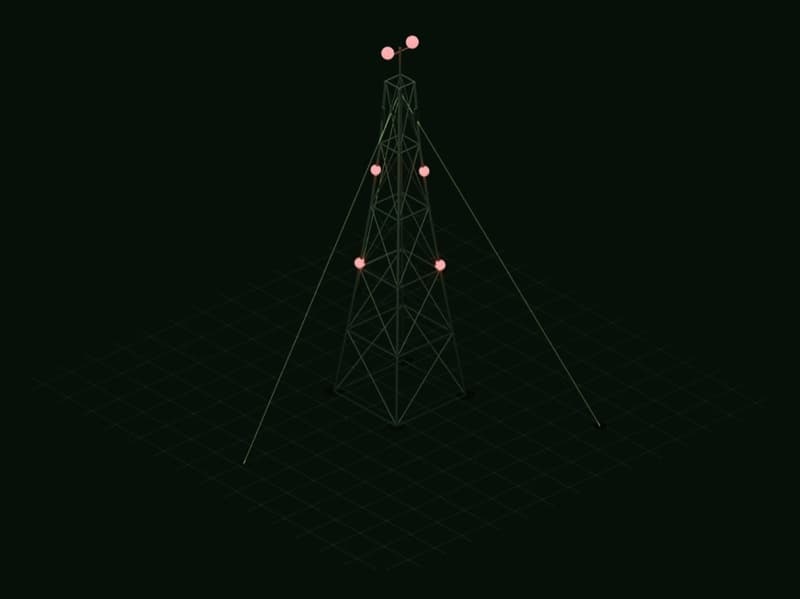
Low intensity obstruction lights are fixed red beacons mounted on structures below roughly 45 metres, marking towers, cranes, rooftops and stacks for night visibility, specified under the low intensity obstruction light provisions of ICAO Annex 14 Volume I. NLS supplies and installs these fixtures across Saudi Arabia sourced from established international aviation lighting manufacturers.
Medium Intensity Obstruction Lights
Medium intensity obstruction lights are flashing red or white beacons for structures roughly 45 to 150 metres tall, giving pilots earlier warning of towers, chimneys and elevated buildings, class selected by the aeronautical study under ICAO Annex 14 Volume I. NLS supplies and installs medium intensity systems throughout Saudi Arabia as part of turnkey obstruction lighting packages.
High Intensity Obstruction Lights
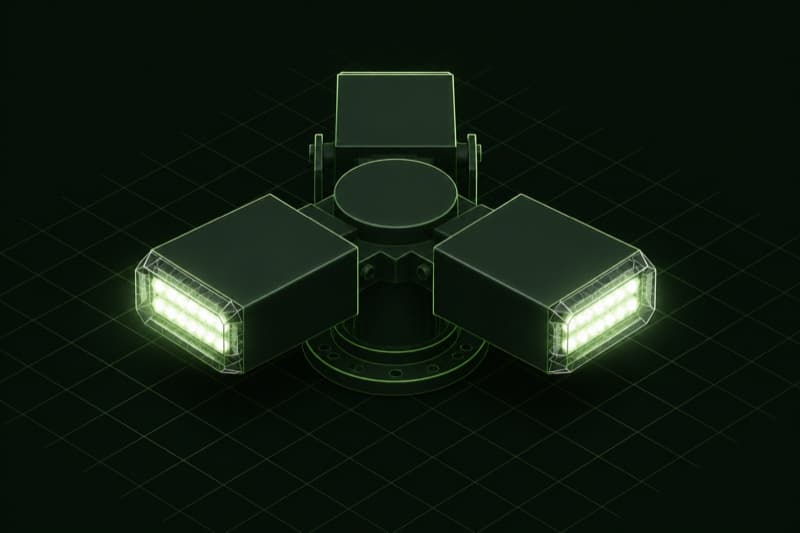
High intensity obstruction lights are powerful white flashing beacons for the tallest structures, transmission towers, tall buildings and offshore platforms, marking them under the high intensity provisions of ICAO Annex 14 Volume I, class set by the aeronautical study, so they remain visible by day and night from long range. NLS supplies and installs high intensity systems in Saudi Arabia.
Solar Obstruction Lights
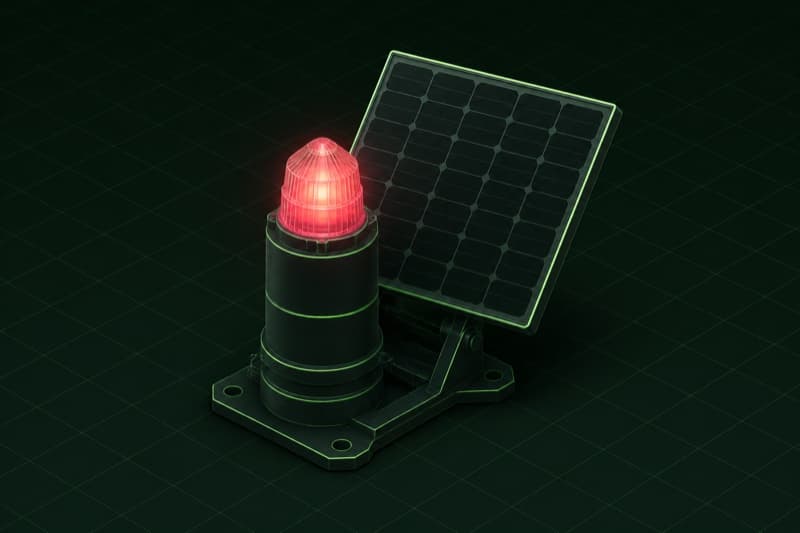
Solar obstruction lights combine a low or medium intensity beacon with an integral solar panel, battery and controller, marking towers, masts and remote structures that have no grid connection. NLS supplies and installs solar-powered obstruction lighting across Saudi Arabia for off-grid sites, sizing the solar and battery capacity to the site's location and duty cycle.

Obstruction Light Monitoring
Obstruction light monitoring is a remote surveillance service that tracks lamp status, power supply and flash synchronization across a structure's obstruction lighting system, alerting the operator the moment a fault occurs instead of waiting for the next physical inspection. NLS deploys and manages monitoring systems alongside its obstruction lighting supply across Saudi Arabia so structures stay continuously compliant.